Who was Jolán Simon?
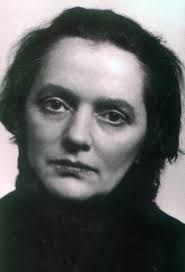
Jolán Simon (31 May 1885 – 25 September 1938) was one of the few Hungarian women artists of the early avant-garde period. Jolán came from a poor family, gave birth to her first child at the age of 17, and by the age of 25 was already a mother of three, working as a worker in a power plant in Budapest. Despite her difficulties, she decided to leave her marriage and left her carpenter husband. It was determining for her that during this period she read Bebel’s book Woman and Socialism and met the later famous avant-garde artist Lajos Kassák, for whom she initially was a model, then became his partner from the 1910s, later his wife. They mutually inspired each other, and she also started to create. Kassák’s visual and literary art, and the unfolding of the avant-garde movement around the magazines he created, called Tett and Ma, would have been unthinkable without Jolán’s active involvement and invisible caring work.
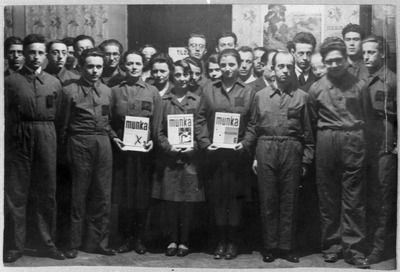
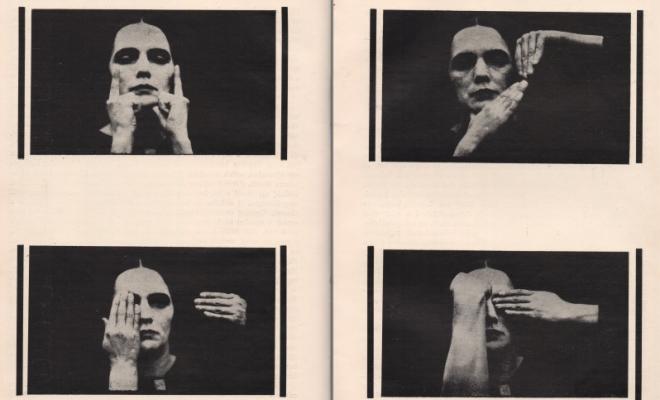
Her Dadaist evenings in Budapest and Vienna, performed with a peculiarly alienating recitative style, with a so-called glass voice, her roles as an actress in mechanical-constructivist stage experiments, her leading roles in the MA-evenings, and her leadership of the political recitation choir of the Workers’ Circle, her workers’ poetry choir, all point to the value, significance, authenticity of Jolán Simon’s creative and committed leftish political artwork.
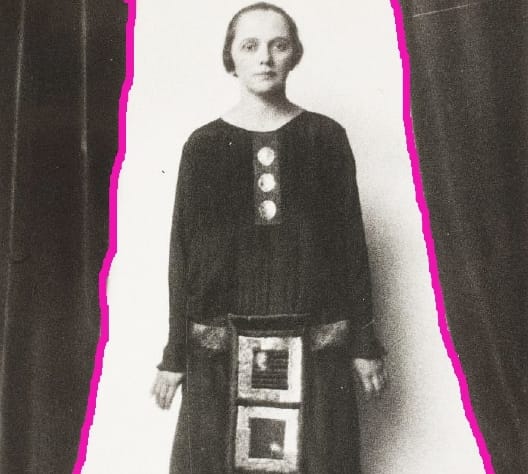
No audio or film recordings of her work have been survived, but a few photographs and newspaper articles, as well as recollections by Kassák and contemporaries, allow us to reconstruct her oeuvre. For example, a photograph of an avant-garde performance dress designed by Kassák, and perhaps sewn by her, has survived.
Jolán Simon worked as a social worker in the last period of her life, in this fascistising political period that ended in the Second World War, without artistic success, in the shadow of a failed leftist revolution and a ceasing movement, and suffered from Kassák’s estrangement and his new partnership. Her life ended in tragic suicide in 1938, in their apartment at Bulcsú Street in Budapest, 9 months after the suicide of their dear friend, the poet Attila József.
For decades, Jolán Simon’s life’s work was forgotten in an inherited patriarchal society, while Kassák’s life’s work became an inescapable part of the Hungarian cultural heritage. Thanks to the literary historian Ferenc Csaplár, Jolán Simon’s oeuvre was processed and presented, but only in 2003, 65 years after her death.
In 2017, a major exhibition entitled Kassákizmus (Kassakism) was held in Budapest in four venues, including Jolán Simon’s oeuvre and early avant-garde theatre, titled Kassákizmus 3. New Drama, New Stage. Experiments in Hungarian avant-garde theatre. It was thanks to this that we discovered her oeuvre and her name was taken up by our art group.
Jolán Simon, a working mother with a conscious choice of social and artistic values, followed the creative path, so her life and artwork is therefore exemplary, despite its tragic end and oblivion.
Following in Jolán Simon’s footsteps, we can counteract the world’s fascistising, violence-based tendencies by representing a conscious set of social values and the power of creating an autonomous creative stance based on women’s experiences.
On 3 December 2023, we presented at Jurányi House in Budapest a performance, called Jolán Simon’s Face to Face, in which we also celebrated her oeuvre.