Photo performance
Gesture politics manoeuvres in public spaces
Gender inequality as a social phenomenon clearly represented by the fact that the number of monuments erected to men is much higher than to women, and that gender inequality is reflected in the representation of women in itself. The often mystified, aestheticised subordinate nature of women can be represented as the muse, the supporter or being idealised and put on a pedestal, even as a femme fatale.
Throughout art history, from antiquity to the present day, these representations of patriarchal norms have been found, and there are many of them in Budapest’s public spaces. We find them so normal that we hardly notice how they depict women in a humiliated or vulnerable position, nor do we complain about the disproportionate lack of representation of women.
We wanted to draw attention to these problems in our ephemeral works created for a few minutes or hours, which we called gesture-political manoeuvres.
We have built on the memorial-political, propaganda or mourning qualities of memorial sculpture.
We will no longer be muses
18 May 2018.
Budapest
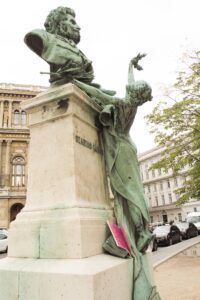
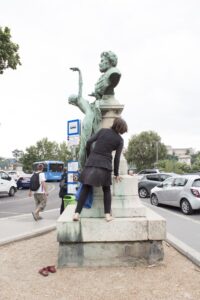
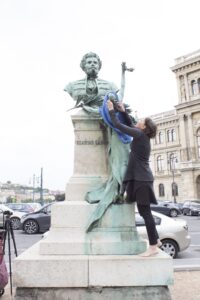
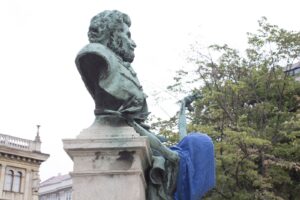
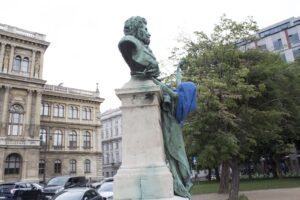
The sculpture we worked on is located in front of the Hungarian Academy of Sciences. Beneath a male figure, we see a half-naked, filigree, beautiful woman, raising her arms in adoration, giving a laurel wreath, smaller in proportion than the man, and whose role is clearly that of the traditionally conceived muse. Although she was conceived of as an allegorical figure, the muse of the guardian of language, this does not change the fact that she also allegorically represents the inferior place and position of the woman in relation to the male figure. Subordinate, adoring the man, staying in the background, invisibly helping him to think the right thoughts and create valuable knowledge for the world to gain money and glory, as opposed to her who could get her nakedness, beauty and her being from a higher divine world.
It is clear that men still dominate the production of knowledge today, just as they did when the statue was created (1899). Women have always been and still are rarely included in academic life and the prestigious positions that go with it, and there are still none in leadership positions in Hungary. As in politics, the gender imbalance in this area is enormous.
By creating our work, by covering the face of the muse, we have given shape to the demand to eliminate the position of the fan, the muse, the invisible background worker.
10 skirts 10 years
19 May 2018.
Budapest
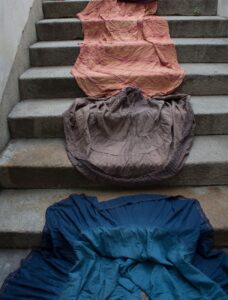
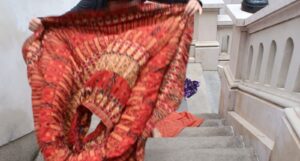
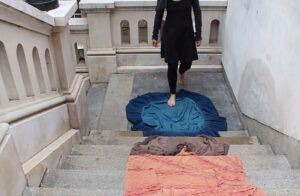
To create our 10 Skirts 10 Years project, we laid 10 skirts on the ground for pedestrians to walk on when they passed by. The path led to the home of Dr. Ágnes Geréb, obstetrician-gynecologist and midwife, where she was serving her 10th year of house arrest, serving a sentence imposed by the court for the death of a baby during childbirth. Mortality around childbirth still exists in our time, even in hospital settings, so a double standard was applied in the investigation. The baby could certainly have died in hospital, too. The popular gynaecologist known to women as Ági, she was attentive to women’s needs from the very beginning of her career, and her proposals and reforms have contributed enormously to the development of obstetrics, the creation of new protocols, the right and practice of fathers to attend births, the improvement of the quality of care for women and babies around childbirth, the promotion of breastfeeding and the choice of home births with professional care in Hungary.
Her path is an example of the enormous struggle women are waging to change a male-dominated system of colluding members, and if we take Ági’s example, failure is inevitable. However, heroic struggles are not in vain, because the sacrificial work is slowly changing the system.
Our work is also mourning, as the big, colourful skirts formerly worn by mothers have been replaced by grey concrete, trampled on by unknown passers-by. We have created our work as a memorial to her to be disgracefully discredited.
A memorial to all women who were forced to live their lives as femme fatale
19 May 2018.
Budapest
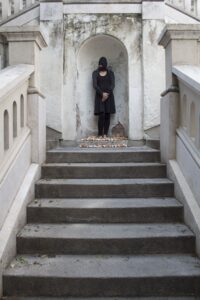
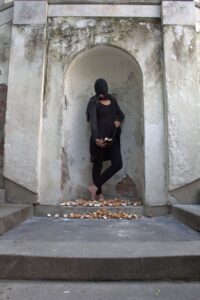
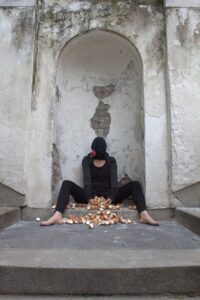
Putting women on a piedestal and the representation of the femme fatale, the “fatally attractive women”, whose function is to depict a woman’s beauty to be admired, serving the male gaze, and to represent the classical ideal of beauty, not secretly with the intention to set an example to all women.
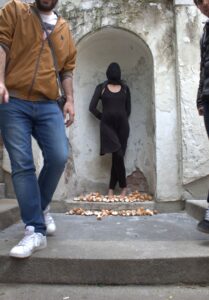
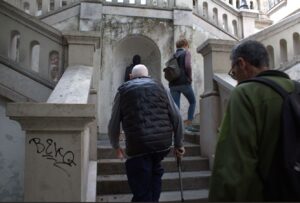
A memorial to every woman who was forced to live her life as a femme fatale, our living sculpture was created in a vacant, ruined sculpture shell. In a combination of a covered face, a black dress, a scattered collection of eggshells and a single rose, the figure assumed various poses and held them out sculpture-like. The intention was to create an anti-beauty, with the broken eggshells suggesting the materiality of nutrition and menstruation, to de-idealize the figure, while the posture of the “sculpture” or the rose would maintain a connection with traditional representations of beauty of the femme fatale.
The title also refers to the agony of the lives of idolized, idealized women, because the lives of models, actresses, stars, women with beauty above average, besides glamour and spectacular appearance, are extremely restrictive. Their lives are basically about their looks and the fear of losing their beauty. So these women can experience a lot of suffering, and we wanted to draw attention to this: what is left of a woman if we take away her physical beauty?
We will be heroes again
20 May 2018.
Budapest
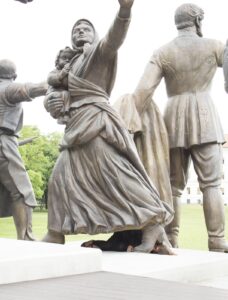
It is part of conservative cultural policy to reinstall public sculptures that were previously demolished. This includes also a group of statues depicting Kossuth’s war recruitment campaign, which was reinstalled in 2018, with a peasant woman with her back turned and a small child in her arms in the middle.
The men – Hussars, peasants, older and younger – go to battle at Kossuth’s call, while the women stay at home with the children. The re-representation of a story that has been played out so many times in history, and the celebration of it with the classically sculpted giant bronze figures, at least two and a half times the size of a man, both represent and propagate a patriarchal, conservative worldview based on nationalism and militarism, and a readiness for war.
The performer hides under the woman’s skirt, recalling the saying: the one who hides behind women’s skirts is a coward. Or does patriotism for her not lead through the violence of war? Does she want to use the power of the sisterhood of women to interrupt the event in progress? At the same time, she puts her head, as it were in a vice, under the heel of her boot, which reminds us that death awaits her at the next movement. Those who go to war are inspired by the narrative that they will be heroes, that they must do ‘what the fatherland demands’ because ‘the fatherland comes first’. The role of women in this situation is also designated: they work for men in the fields, raising children, caring for the war-wounded, or in the arms factories, and their reward is that they are also heroes. Is there a choice? Or does the militant regime again and again satisfy its people by allowing them to become heroes in wars on the altar of a homeland led by a political and economic patriarchal elite? Can humanity ever exist without wars? Will there ever be a system other than one based on militarism and elitism? Can we be and will we be heroes again?
Open propaganda: women, read every day!
21 May 2018
Budapest
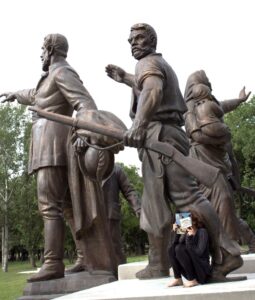
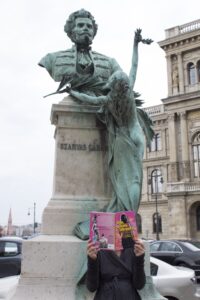
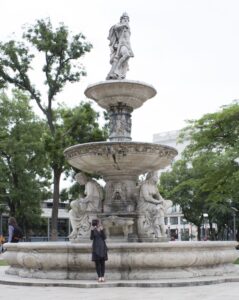
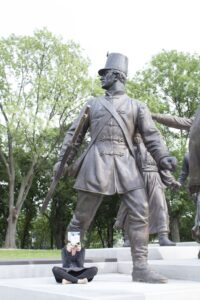
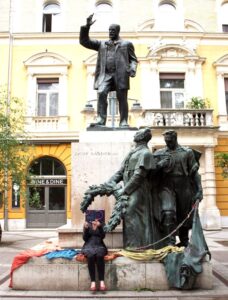
The performer will show some of the books from the international feminist literature at sculptures where men’s heroism is celebrated or women’s second-class status is clearly visible. Access to and reading of books is a free opportunity that can help women to become aware of and articulate the patriarchal system they themselves play an active role in re-creating. It is an opportunity for their empowerment and the creation of a vision for their future, so we set out to propagate reading.
The photos provoke with the title. They are intended to draw attention both to the sometimes uncultivated, uneducated situation of women, who are not aware of their own situation and role to keep the system going, and to the possibility and importance of acquiring knowledge independently of institutions. Self-education is an inescapable task if we want to change a patriarchal system that is set in stone and seems immutable.
F#ck the Hungarian Parlament
(Ai Weiwei paraphrase)
23 April 2020.
Budapest
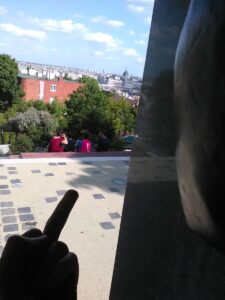
In his 2017 work F#ck the White House, Chinese artist Ai Weiwei used the well-known hand sign in a series of photographic performances, in this case to denigrate the work of political actors in the White House. We created our work along the same lines, growing Ai Weiwei’s political message movement into a global movement. Our picture was taken standing in the monument to the martyrs of the 1956 revolution in Budapest. From here, our finger clearly points towards the Hungarian Parliament, and from here we sent a message on behalf of the victims that they did not give their lives for the country we live in today.
In April 2020, in line with the values of the government in power, the speaker of parliament made a comment on a female opposition politician in public media, devaluing her and the very small number of women MPs in national politics, saying “I feel pity for these MPs, especially those whose personal number starts with 2.” (Because the first digit of the Hungarian personal number indicates gender: one: male, two: female.) With this statement, he has displayed the patriarchal hierarchy of values and has put her in place, as a female MEP, how she comes to criticise the government’s political action.