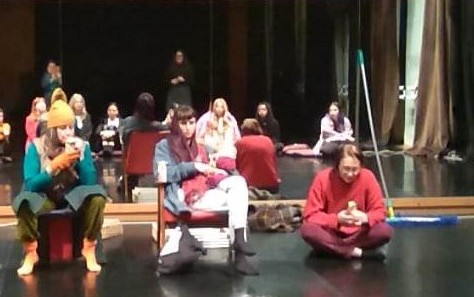
Jurányi House, Budapest
School of Disobedience performance evening
5 March 2024.
English language
10′ 11”
The performance is about the precarious situation of working and art creating women.
Action. There are three performers, one of them with her baby, so four of them.
The action consists of two parts. Active part: cleaning, mopping the floor, putting chairs away, tidying up. Passive part: three women sit down and sip juice from a can labeled JOY. It’s like they’re on a break from work. Because they are sitting in front of a large mirror, the audience can see themselves and be part of the action. What applies to the performers applies also to the audience.
Throughout, one can hear a sound montage.
The mopping up takes place during the female singing of ” I am”.
The main motifs of the sound montage are phrases reflecting the main ideas of Hito Steyerl’s Politics of Art: Contemporary Art and the Transition to Post- Democracy. The quotations from the text were spoken by an artificial intelligence imitating a female voice.
These are the key sentences: „I guess that apart from domestic and care work, art is the industry with the most unpaid work around.” „Free labour and ramped exploitation in the dark matter keeps the cultural section going.” „Self-exploiting acters.” “Be yourself, express your identity! Be fantastic! Look like no one else! Look like Frida.”
Another text: in a big, echoing lecture hall, we can hear a male speaker who talks about negotiations, improving the situation in the world, equal opportunities, but his speech remains only a barely audible background noise, expressing that for decades they have been saying these things at conferences, yet there has been no progress on the level of the system, these texts by now are just background music to our ears. In contrast, the Steyerl text fragments on this soundtrack are clearly audible.
The phrase “Look like Frida” refers to Frida Khalo, whom the culture industry has turned into an icon and a source of numerous sources of income, fetishising and thus devaluing her life of suffering and the art that grew out of it. This passage sounds like an advertising slogan based on self-fulfilment as the most important value, and as it is repeated more and more, it becomes increasingly annoying. It runs into audio footage collected from a school event teaching children to cheer, when students went to a football match with their PE teachers and came up to a Budapest metro station shouting ria-ria-hungaria. The phrases representing the cult of identity thus degenerate into an education in nationalism. Then the female singer tries to over-sing it hopelessly (by continuing the song “I am”).
Steyerl refers to Gregory Sholette’s Dark Matter – Art and Politics in the Age of Enterprise Culture when writing about the competing capitalist art industry actors fighting for resources, they are the precarious class, the dark matter of society.
We ourselves, who created this work, could only do so at the cost of self-exploitation. The words ‘self-exploiting artists’ are repeated over and over again at the end of the text. The meaning of the use of the large ballet mirror becomes clear. One day we are needed on the market, the next day we are dismissed. We live in alternations of being hired and fired The system is becoming more impersonal and cruel, and competition with artificial intelligence is the next stage. Our passivity is at once cluelessness, defeatism, disillusionment. Or is it preparation for change? What will be the next step? In our hands, the baby, who needs the future. She is watching us all.